For twenty years, SaaS sold the same promise: you rent a tool, you do the work with it. The software structured the task, the user carried it out. The entire economics of the sector — per-seat pricing, onboarding, adoption, usage rate as the sovereign metric — follows from that promise.
AI does not make that promise obsolete by being better. It replaces it with another one, different in kind: you rent a service, the software does the work, you validate the outcome. This is what we call the move from Software as a Service to Service as a Software — a change of paradigm, not one more feature.
The difference, in one image
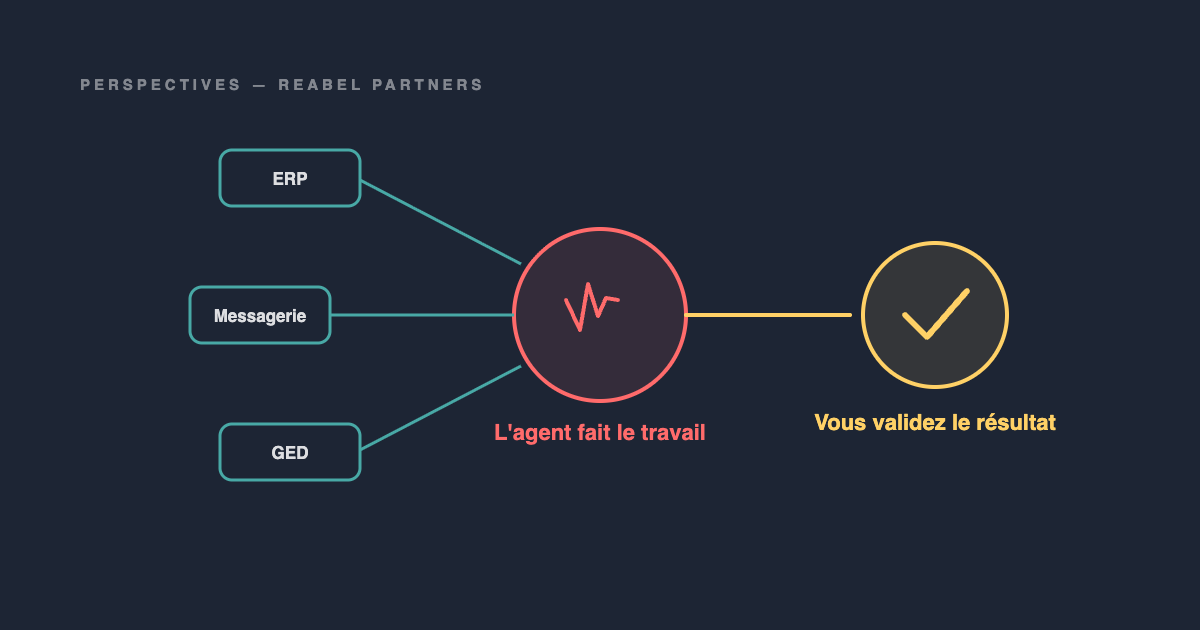
Classic SaaS hands you a car: you drive. Service as a Software hands you a driver: he proposes the route, you approve it, you remain in command.
In practice, the agent — call him Otto — no longer displays a form for handling incoming requests: he reads the request, qualifies it, queries the ERP, drafts the reply, triggers the business action. The user — call her Sophie — no longer keys in data: she arbitrates. Every decision Sophie makes is a learning signal. On day zero, Otto is generic; by day ninety, he is a specialist in this customer, its suppliers, its unwritten rules. Sophie has moved up a level — and she has taken Otto up with her.
Under the bonnet: a brain and hands
What makes this possible is neither a rules engine nor one more workflow:
- A brain: the LLM. A model that draws regularities from millions of examples instead of executing frozen `if/then` statements. This is probabilistic AI: pattern, context, judgement.
- Hands: the tools. Through tooling protocols (MCP and its kin), the agent calls on what it needs, when it needs it: email, telephony, ERP, document management. It is not an automaton; it is an agent.
- A guardrail: human validation. The result is proposed, sourced, traceable — and approved before it commits the company. Human review is not a concession: it is the very architecture of trust.
What it changes for a software company
For an established SaaS company, the strategic consequence comes down to three shifts:
- Value moves from the tool to the outcome. Customers will not pay seats much longer for work the software can do; they will pay for the work done. Pricing, packaging and usage metrics all need rethinking around the validated outcome.
- Domain know-how becomes the differentiating asset. LLMs are available to everyone — your competitors included. What they do not have: your proprietary data, your business rules, twenty years of solved cases. Wrapped in guided workflows with sourced answers, those make a difference no generic model can close.
- The build chain changes too. Assisted code generation, systematic review, corpus governance: the R&D that makes these products already looks nothing like yesterday's.
The opportunity, not the threat
The anxious reading — AI will kill SaaS — aims at the wrong target. What AI threatens is interchangeable tool-software. What it multiplies is domain software fed by proprietary data and sector expertise. The future belongs to the companies that seize it as an opportunity: those who combine an intimate knowledge of their customers' business with these new capabilities — and who transform their promise before a newcomer does it for them.
The transition is not improvised: doctrine and data sovereignty first, prioritised use cases next, an agnostic architecture, then packaging and go-to-market. That is the path we run with software companies — end to end, all the way to revenue.