
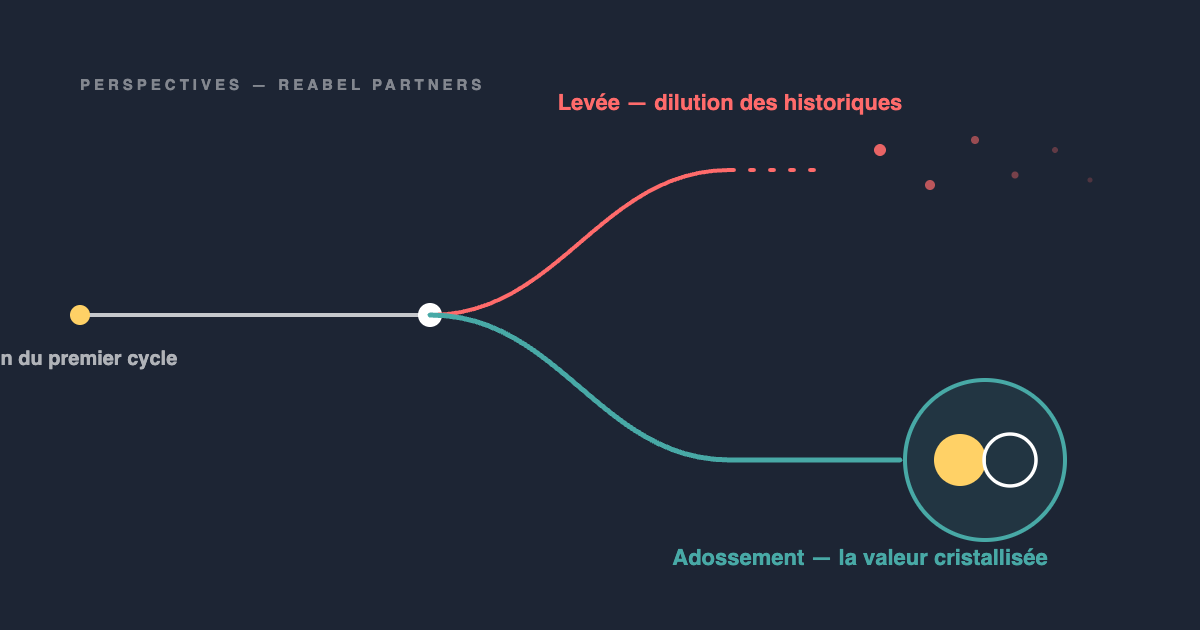
There comes a moment in the life of a software company when the question is no longer « how do we grow » but « with whom, and at what price ». The start-up has delivered: the product is established in its market, revenue is recurring, EBITDA is approaching or past breakeven. The first cycle is closing. Financing the second one — commercial acceleration, geographic expansion, acquisitions — takes capital. And that is where the most structuring decision in the company's history is made.
The reflex to raise — and its blind spot
Raising is the natural reflex. It looks good in the press, it appears to leave the keys with management, and the entire ecosystem — investment banks, funds, media — is organised to produce it.
Its blind spot is considerable, and it rarely concerns those who sign the press release: the long-standing shareholders. Founders, early business angels, family offices that came in at the start — those who carried the initial risk. For them, a raise at the end of the first cycle means, almost mechanically:
- dilution, reducing their share of the capital at precisely the moment the company starts to be worth something;
- marginalisation in governance, as the new investor naturally negotiates rights commensurate with the cheque;
- deferred liquidity: the newcomer is here for the second cycle, not to buy out the first. The exit horizon moves five to seven years away.
None of these effects is illegitimate. But they should be chosen, not endured.
The alternative: a strategic sale
The other path is to sell the company to a major industrial operator — one whose portfolio, customer base and geographic footprint multiply what the software company has built.
That choice changes the nature of the transaction. A fund buys a future trajectory and finances it in stages; a strategic operator buys immediate synergies — and is prepared to pay today for the value those synergies will create tomorrow. For long-standing shareholders the difference is tangible: the valuation recognises the ground already covered, the liquidity is real, and employees join a group offering stability and prospects.
A sale does, however, demand work that a raise does not: defining the profile of the ideal operator. Critical mass, financial strength, complementary product portfolio, the ability to integrate without destroying — the right acquirers do not present themselves, especially when the process under way is only looking at funds. They must be identified, convinced of the strategic case, and brought to an offer that reflects the company's real position in its market.
A decision framework in four questions
- Where are you in the life cycle? A hyper-growth, pre-profitability company needs fuel: raising is its instrument. A mature, profitable company needs a multiplier: that is the ground for a strategic sale.
- What do the shareholders actually want? To carry the risk five more years, or to crystallise the value created? An honest answer to that question eliminates half the scenarios.
- Is there an operator who creates synergies? If a player exists for whom the company is structurally worth more than it is to a financial investor, the valuation gap can be substantial.
- Who defends the shareholders in the process? Management and their bank run the company's process; the interests of long-standing shareholders need their own adviser — a distinct role, and one that weighs on every parameter of the deal.
What experience shows
We advised the co-founding shareholders of a real-estate data platform facing exactly this dilemma: a fundraising process under way, dilution announced, personal wealth at stake. The analysis concluded in favour of a strategic sale; the ideal operator profile was defined, the acquirer identified and approached, the opportunity argued — through to an investment of up to €100m by the European leader in the sector. The full account is in our Stonal × Aareon case study.
The lesson holds in one sentence: at the end of the first cycle, the question is not « how much can we raise » but « which trajectory best serves the company, its employees and those who built it ». Answering it takes analysis — not a reflex.