
It is the most frequent question in our first conversations with a founder: « My SaaS does X million in ARR — what is it worth? » It almost always invites the same false answer: a multiple, picked up from a barometer, applied mechanically. That arithmetic is reassuring. It is also the surest way to be wrong — in either direction.
The multiple does not measure value, it summarises it
An ARR multiple is not a price: it is a snapshot, at a given moment, of what buyers paid for comparable companies. Yet two software companies with the same ARR almost never have the same value. Between a €5m ARR business growing 40% with 115% net retention, and a €5m ARR business growing 8% with churn masked by one-off sales, the valuation gap can be threefold — for the same « ARR » line in the spreadsheet.
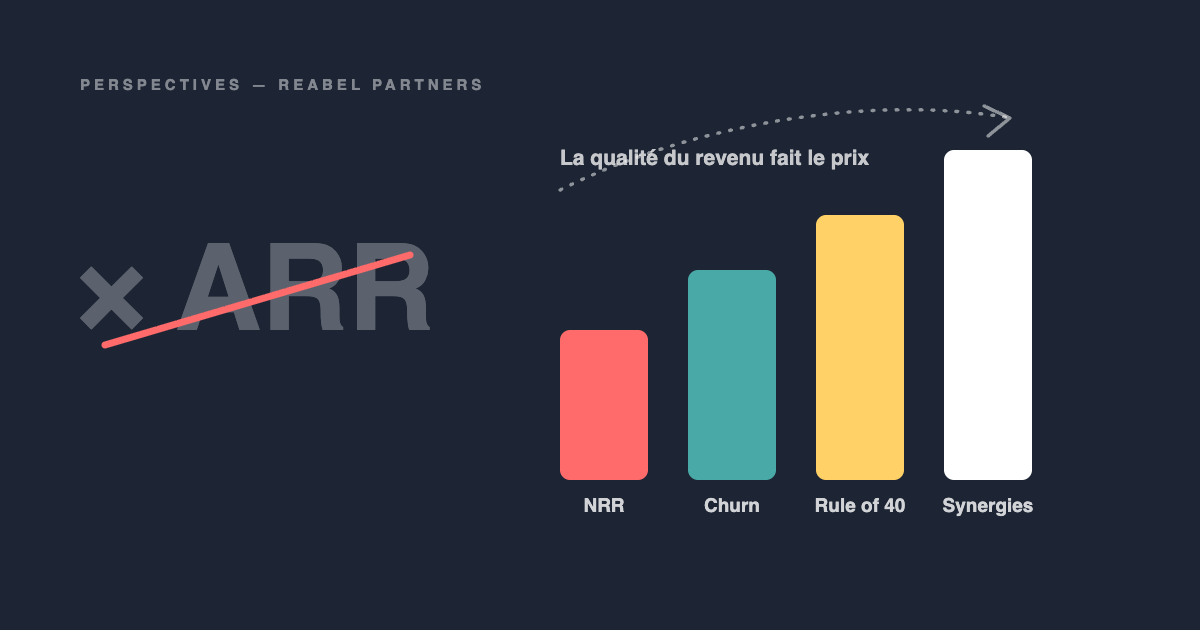
What serious acquirers pay for is not revenue: it is revenue quality. It reads in a handful of indicators:
- Net revenue retention (NRR) — the decisive test. Above 110%, the company grows without selling; below 90%, it is running on a treadmill going backwards.
- Churn, by logo and by value — and above all its structure: losing ten small accounts does not mean the same thing as losing your largest one.
- The Rule of 40 — growth plus margin: the discipline that separates bought growth from profitable growth.
- The contract mix — commitment length, indexation, the share of genuinely recurring revenue versus services and licences in disguise.
- Customer concentration — an ARR where 30% rests on two accounts trades at a discount, whatever the barometer says.
What the multiple does not see at all
Beyond the metrics, a decisive share of value — or of discount — appears on no dashboard:
- Product debt. A modern platform and a sound architecture speed up integration for an acquirer; a legacy stack to be rewritten is paid for in years, and deducted from the price.
- Founder dependency. If sales, product and the key accounts all rest on one person, the acquirer is buying a risk — and will price it.
- Position in the customer's value chain. Software at the heart of its users' work is hard to replace; a peripheral tool is benchmarked at every renewal.
- Synergy potential. This is the most asymmetric factor of all: to the strategic acquirer whose portfolio and customer base complement yours, your company is structurally worth more than it is to any financial investor. Identifying that acquirer changes the entire range.
The right method: build the case before pricing it
A serious valuation is a conclusion, not a starting point. Our practice — pre-due diligence — consists in building the file the way a demanding acquirer would, but in the seller's service: analysis of past performance (growth, profitability, cash flow), revenue quality, the three-to-five-year budget trajectory, product debt, team, and possible synergies by acquirer profile. That work produces three outputs:
- a substantiated valuation range, defensible in negotiation because every euro can be explained;
- a list of high-leverage fixes — the six- to eighteen-month projects that genuinely move the multiple (retention, contract mix, reducing founder dependency);
- a thesis per acquirer: who the company is worth most to, and why.
The paradox deserves stating plainly: the best moment to build your valuation case is not the eve of a sale, it is two or three years before. That is how long it takes to turn a multiple you endure into one you choose.